
Originally published January 4, 2022 from field notes by Evan. Restored and lightly edited in 2026.
A client came to Element 7 with an unusual production challenge: create a 180° nature-to-city ASMR experience that would let viewers put on a virtual-reality headset and move from the forests of the Pacific Northwest into the heart of Seattle.
The concept sounded simple—a peaceful walk through beautiful environments—but immersive production changes the rules. The camera operator needed to walk for extended takes, keep a dual-lens VR camera stable, stay out of the frame, manage power and recording, and avoid movement that could make the headset experience uncomfortable.
This is how our team built the rig and captured the production.
The camera system
We used the ZCAM K1 PRO, a stereoscopic 180° camera with two wide-angle lenses. Each lens records to its own media, and the camera connects to the ZCAM Controller app over Wi-Fi for monitoring and settings.
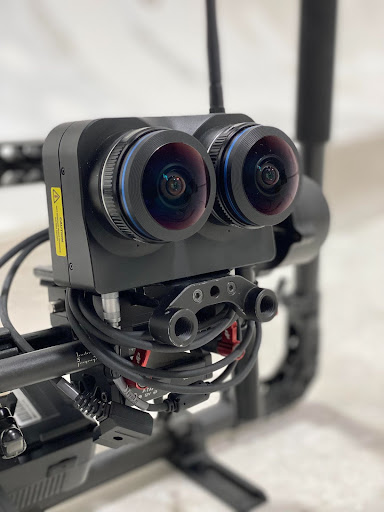
That wireless control was useful, but the connection could be temperamental in the field. When the phone lost contact with the camera, the two recording indicators became our essential confirmation that both sides were still rolling.
With immersive capture, reliability matters twice: losing one eye of a stereoscopic recording can make the entire take unusable.
Building a walkable 180° camera rig
Our next challenge was creating a rig stable enough for VR but light enough to carry through repeated ten-minute walking takes.
We began by balancing the camera on a Ronin stabilizer. A V-mount battery powered the system and also helped counterbalance the camera. During studio tests, we discovered that the operator’s feet appeared at the bottom of the 180° frame. We repositioned the camera as far forward as the rig allowed to keep the operator out of view.
That solved the framing problem but created a physical one. Holding the camera away from the body quickly became exhausting and made smooth movement harder to maintain.
We added a Ready Rig to redistribute the weight across the operator’s torso. The support system reduced arm fatigue, but it required careful adjustment. Too much tension transferred bounce into the camera; too little left the operator carrying the full weight.
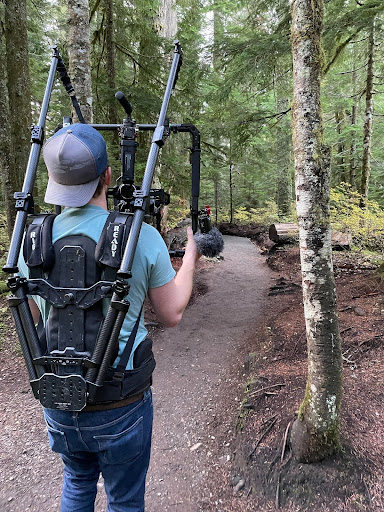
The team rehearsed in the studio until the operator could walk slowly, turn gradually, and hold the rig consistently without introducing the vertical bounce that can become uncomfortable inside a headset.
Location one: Franklin Falls
Shoot day began at sunrise near the Franklin Falls trail in the Cascade foothills, just before Snoqualmie Pass.
We set the camera to ISO 400 and used automatic shutter adjustment to respond to the trail’s changing mix of shade and direct sunlight. The hardest part was not exposure—it was movement. Every turn had to be deliberate, and every footstep had to minimize bounce.
The operator also needed to manage the Ready Rig continuously. Small changes in posture or terrain affected how much weight the system carried and how much movement reached the camera.
We recorded roughly ten trail walks along the Franklin Falls route before moving into Seattle for the second half of the production.
Location two: Pike Place Market
The first city sequence began in Post Alley, moved past the Gum Wall, looped through Pike Place Market, and finished near the market’s famous fish-throwing vendors.
An unusual 180° rig attracts attention. Bystanders frequently stopped, stared, followed the operator, or took photos—sometimes entering and disrupting a take that had already been running for several minutes.
Immersive production offers fewer places to hide crew, equipment, or curious pedestrians. Because the camera sees so much of the environment, location timing and crowd awareness become part of the technical workflow.
After several attempts, we captured enough uninterrupted material to complete the city portion confidently.
Location three: Alki Beach
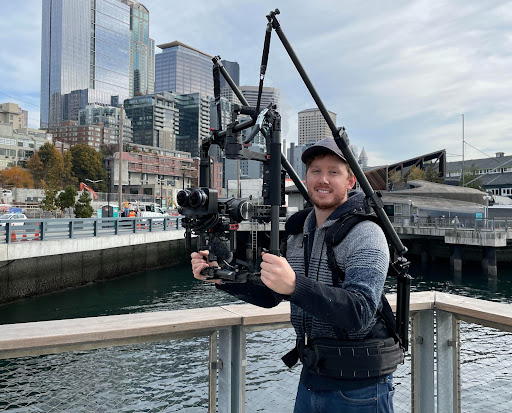
We finished across Elliott Bay at Alki Beach, with the Seattle skyline behind the operator.
The paved route created a more consistent walking surface, and the lighter pedestrian traffic made it easier to complete long takes without interruptions. After the variable terrain at Franklin Falls and the crowds around Pike Place, Alki provided a controlled final environment for the day.
What we learned
This production reinforced several lessons that apply to immersive camera work:
- Test the entire physical system before location day. Camera balance, battery placement, operator visibility, and support tension all affect the final image.
- Design for the viewer’s comfort. Walking speed, turns, vertical bounce, and horizon stability matter more in a headset than on a conventional screen.
- Plan for attention. A specialized rig draws crowds, especially in public locations.
- Record multiple long takes. A pedestrian, connection issue, or moment of instability can spoil an otherwise strong immersive sequence.
- Treat the operator as part of the stabilization system. Rehearsal and physical consistency are as important as the gimbal.
The finished shoot moved successfully from mountain trail to dense city environment to open waterfront—three very different locations connected through one continuous immersive idea.
Have an unconventional camera, location, or immersive-production challenge? Tell Element 7 what you are planning.